
NodieClaw: The Production-Ready Way to Use OpenClaw
OpenClaw is one of the most interesting agent runtimes available today. It gives developers a flexible foundation for running agents, connecting channels, loading skills, and turning chat into something much more capable than a simple assistant window.
But once you move beyond the demo stage, a new problem shows up: OpenClaw is powerful, yet most teams still need a product layer on top of it. Installation is only the beginning. After that come server setup, channel wiring, credentials, model access, billing, skills selection, and the question almost every serious user asks: what exactly is the agent doing right now?
That is the gap we are closing with NodieClaw. NodieClaw is not a replacement for OpenClaw. It is the production-ready way to use OpenClaw.
OpenClaw gives you the runtime. NodieClaw gives you the product experience.
In its raw form, OpenClaw is best understood as a powerful engine. It is extensible, developer-friendly, and capable of much more than a typical chatbot. But most real users are not looking for an engine. They are looking for something they can use today.
That means solving a different set of problems:
- How do users start without running their own stack?
- How do they talk to the agent in Telegram, WhatsApp, or Feishu instead of a local dev interface?
- How do they connect Google Workspace, Notion, Slack, GitHub, and similar tools without handling credentials manually?
- How do they get useful skills on day one instead of spending time assembling a skill set?
- How do they understand cost, usage, and what the agent is actually doing?
NodieClaw is our answer to those questions. We keep the OpenClaw core, then add the operational and product layers that make it feel ready for real use.
1. Real messaging channels, ready to use
A lot of people think “using OpenClaw” means getting the runtime to boot. In practice, the real moment of adoption happens when an agent can meet users where they already work. That is why NodieClaw is built around real channels, not just local setup.
With NodieClaw, the goal is simple: you should be able to use the agent through channels like Telegram, WhatsApp, or Feishu without turning channel integration into your own infrastructure project.
This matters more than it sounds. Once an agent can live inside familiar messaging surfaces, it stops feeling like a developer experiment and starts behaving like a real product.
2. Curated and preinstalled skills instead of setup fatigue
OpenClaw is flexible, and that flexibility is one of its strengths. But flexibility also creates friction. If every user needs to discover, compare, install, and configure skills on their own, many never reach the point where the system becomes useful.
NodieClaw takes a more opinionated product approach. We curate and preinstall the high-frequency capabilities users actually want, including:
- writing and editing documents
- creating presentations and PPT-style outputs
- working with tables and spreadsheets
- generating images
- using GPT-4, Claude, and Gemini through one product layer
- connecting services like Google Workspace, Notion, Slack, and GitHub
If you want the broader product context behind this direction, our earlier post on agentic workflows explains why usability and execution speed matter just as much as raw capability.
3. A simpler credentials layer for real work
Most agent products do not fail because prompting is hard. They fail because real work needs access. The moment an agent needs Gmail, Drive, Docs, Sheets, Notion, Slack, GitHub, or some other external tool, credentials become the bottleneck.
NodieClaw solves this with a unified credentials layer, so users can connect services once and let the agent use them when needed. Instead of scattering OAuth and API keys across multiple tools and configs, we turn access into part of the product experience.
For users who want to explore that side of the product, we already surface a dedicated credentials experience inside the site.
4. Unified model and service access
Another practical problem with self-assembled agent stacks is fragmentation. One provider for one model, another provider for another model, separate accounts for data services, separate billing, separate failure modes, and separate mental overhead.
NodieClaw simplifies that by giving users a unified way to access models and external services through Nodie. Instead of managing every upstream platform separately, users operate through a single product layer with simpler usage and simpler billing.
For many users, this is not just easier. It is often more practical and more cost-effective than maintaining multiple subscriptions, credentials, and service relationships on their own.
5. The biggest upgrade: visible execution instead of black-box behavior
This is the most important part of NodieClaw.
A lot of agent tools can produce an answer. Far fewer can show the user what happened during execution in a way that is actually understandable. That lack of visibility is one of the biggest reasons agents feel hard to trust.
When an agent runs, users want to know:
- what steps are being executed
- which routine is currently active
- what tools were called
- whether the system is still running, waiting, or finished
- how the final output was produced
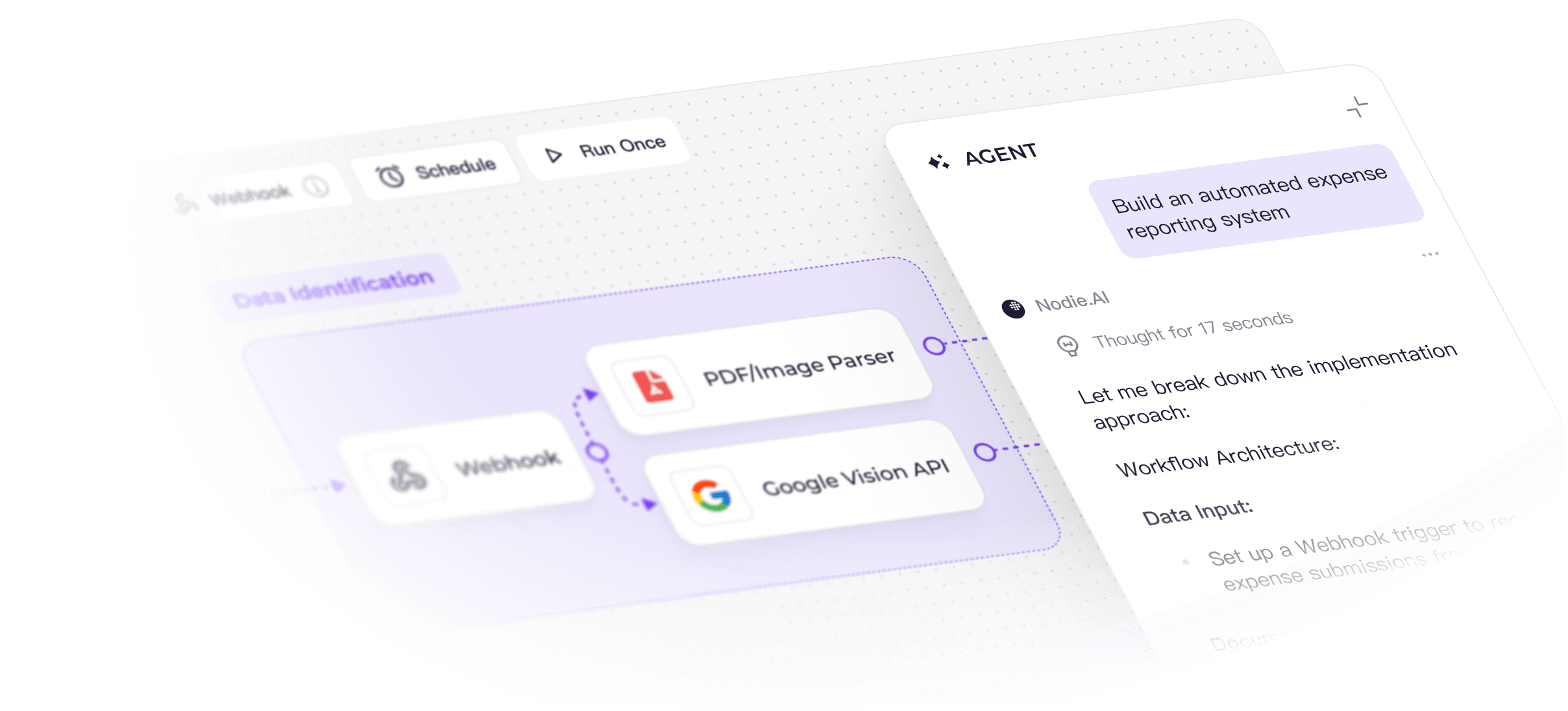
We are addressing that by connecting NodieClaw with the Nodie Workflow Canvas. The conversation remains the user-facing interface, but execution is no longer hidden behind it. Users can inspect the workflow, see the routine structure, and understand how the result is taking shape.
In other words, we do not want the agent to feel like a black box. We want it to feel observable.
Why this matters for the future of OpenClaw
We think this is the natural next step for the OpenClaw ecosystem. OpenClaw has already shown what a capable runtime can look like. The next challenge is making that power accessible to teams that care less about infrastructure and more about shipping useful agent experiences.
That is why we describe NodieClaw as the production-ready way to use OpenClaw. Not because we are replacing it, but because we are taking the raw runtime and closing the gap between capability and usability.
Who NodieClaw is for
NodieClaw is a good fit if you want the power of OpenClaw but do not want to build the whole product layer yourself.
- Teams that want a usable OpenClaw-based product instead of a runtime project
- Users who want agents inside Telegram, WhatsApp, or Feishu
- People who need practical skills from day one
- Operators who want one place for credentials, models, and billing
- Anyone who wants to see how an agent works instead of trusting a black box
Conclusion
OpenClaw is already a strong foundation. What NodieClaw adds is the missing product layer: channels, curated skills, unified access, and visible execution.
If OpenClaw is the engine, NodieClaw is the production-ready way to use it.